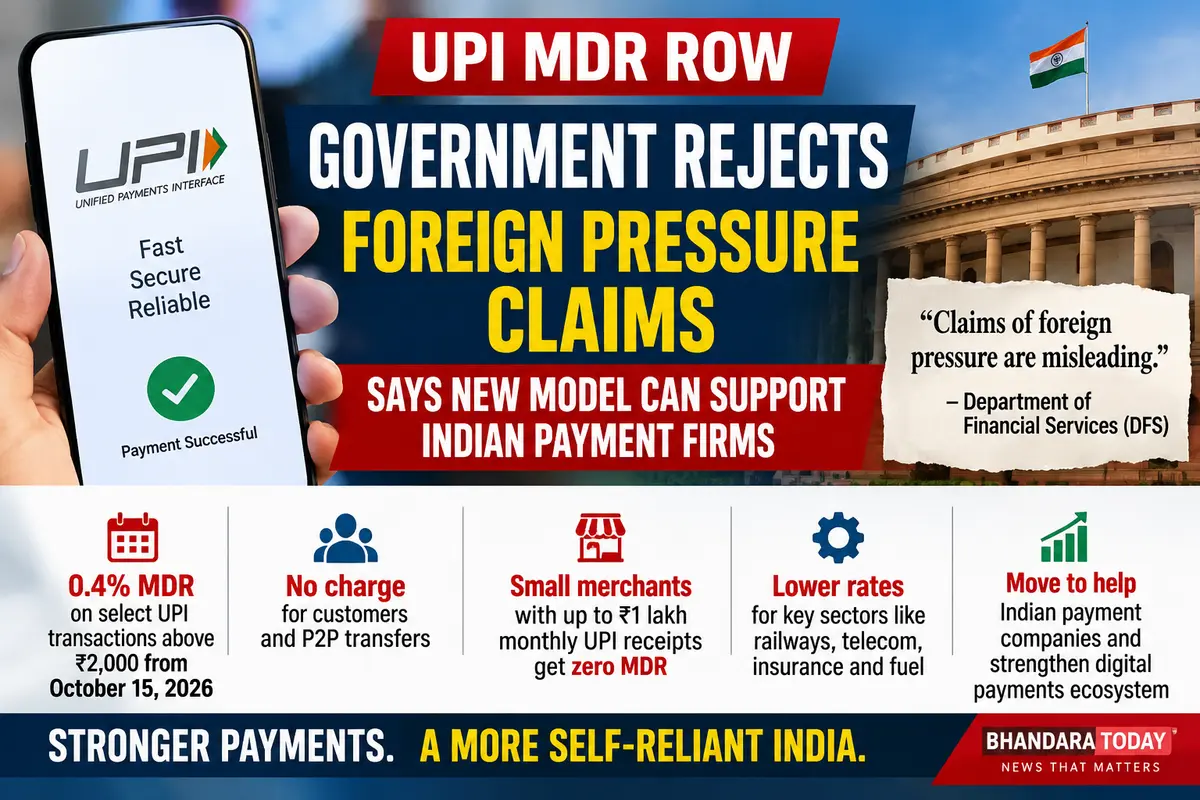
New Delhi: The Centre has rejected allegations that the decision to introduce a Merchant Discount Rate (MDR) on selected UPI transactions was taken because of pressure from the United States or any other foreign country. The government has described such claims as misleading and said the move is aimed at creating a more sustainable digital payments ecosystem in India.
The Department of Financial Services (DFS), under the Ministry of Finance, said that introducing MDR on selected high-value UPI transactions could create additional revenue opportunities for domestic companies operating in the digital payments sector.
According to the department, the move could encourage more Indian companies to participate in the UPI ecosystem and invest in payment technology, infrastructure and security.
New MDR framework to take effect from October 15
Under the new framework announced by the National Payments Corporation of India (NPCI), selected Person-to-Merchant (P2M) UPI transactions above ₹2,000 will attract an MDR of up to 0.4% from October 15, 2026.
For transactions of ₹75,000 or more, the MDR has been capped at ₹300.
The new framework does not mean that customers will have to pay a fee every time they use UPI. The MDR is a charge within the merchant payment ecosystem and is not being directly imposed on consumers for making UPI payments.
Person-to-Person (P2P) transfers, where money is sent from one individual to another, are also outside this MDR structure.
No MDR on UPI transactions up to ₹2,000
Transactions of up to ₹2,000 remain outside the new MDR structure. Special provisions have also been made for smaller merchants.
Under the framework, eligible small merchants receiving up to ₹1 lakh through UPI QR transactions in a month can continue to qualify for zero MDR under the applicable P2PM category.
This provision is intended to reduce the impact of the revised system on smaller businesses that depend heavily on digital payments.
Why is MDR being introduced?
UPI has expanded rapidly across India, with billions of transactions being processed every month. Operating such a large-scale digital payment network requires significant spending on technology infrastructure, cybersecurity, fraud prevention and technical support.
In August 2026, UPI processed around 24.51 billion transactions, with the total transaction value reaching approximately ₹29.9 lakh crore.
The government and NPCI have argued that a sustainable revenue mechanism is becoming increasingly important as the digital payments ecosystem grows.
Revenue generated through MDR is expected to support participants in the payment ecosystem and could help fund investments in infrastructure, technology, innovation and security.
Special rates for selected sectors
The new structure also provides different rates for certain essential service categories.
For sectors such as railways, telecommunications, insurance, fuel and selected utility services, eligible transactions above ₹2,000 will attract a flat MDR of ₹5.
Certain capital-market-related transactions will have a much lower MDR of 0.02%, subject to a maximum charge of ₹300.
The applicable rate therefore depends on the type and category of the transaction rather than applying one uniform charge across all UPI payments.
What does the move mean for Indian UPI companies?
The introduction of MDR creates a potential revenue stream for various participants in the digital payments ecosystem, including banks, payment applications and technology service providers.
The government's position is that a more sustainable financial model could encourage domestic companies to develop new payment products and strengthen existing infrastructure.
It could also provide companies with greater scope to invest in cybersecurity, fraud detection and other technologies required to support India's rapidly expanding digital payment network.
Opposition questions the decision
The MDR announcement has also attracted criticism from opposition parties and sections of the business community. Concerns have been raised over the possibility of increased costs for some merchants and the broader impact of introducing charges into a payment system that has traditionally been promoted as low-cost and widely accessible.
The government, however, maintains that the new framework includes safeguards and exemptions intended to protect consumers and smaller merchants.
The debate over UPI MDR is therefore centred on two aspects: maintaining the affordability and accessibility of digital payments while also creating a financially sustainable ecosystem capable of supporting India's growing UPI infrastructure.
With UPI continuing to handle an enormous volume of transactions every month, the new MDR framework is expected to become an important part of the discussion around the future financing of India's digital payment ecosystem.