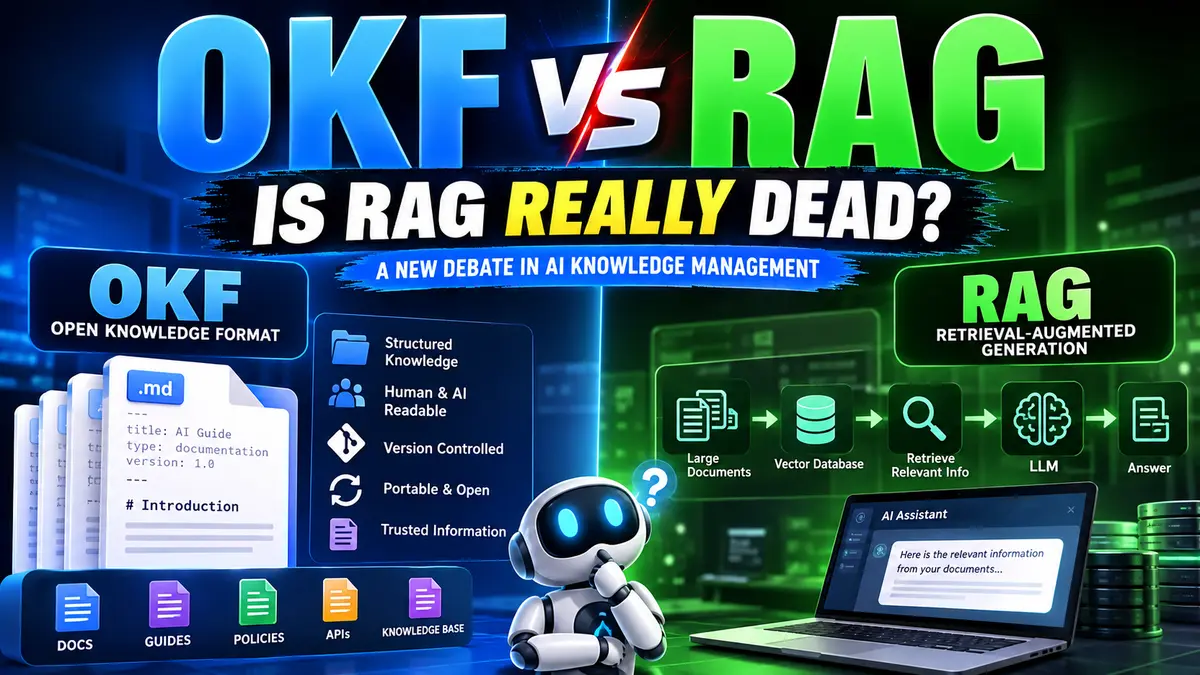
New Delhi, September 24, 2026: Artificial intelligence is moving beyond the race to build more powerful language models. As AI agents become more capable, another question is gaining attention: How should reliable knowledge be organized and delivered to AI systems?
That question has brought the Open Knowledge Format (OKF) into the spotlight.
OKF is designed to make knowledge easier for both humans and AI agents to access, manage and share. Its emergence has also triggered discussions among AI developers about whether traditional Retrieval-Augmented Generation (RAG) architectures could change in the coming years.
However, OKF should not automatically be considered a replacement for RAG. The two technologies address different parts of an AI knowledge system.
What Is Open Knowledge Format?
Open Knowledge Format, commonly known as OKF, is a way of packaging knowledge in a structured and portable format.
The format primarily uses Markdown files along with YAML metadata. This allows knowledge to remain human-readable while also making it easier for software and AI systems to process.
Organizations can use this approach for technical documentation, business rules, product information, internal guides and other forms of curated knowledge.
How Is OKF Different From RAG?
The easiest way to understand the difference is to look at what each technology does.
OKF focuses on how knowledge is represented and organized.
RAG focuses on how relevant information is retrieved and supplied to an AI model.
For example, imagine a company has thousands of internal documents. Important and verified information could be maintained in a structured knowledge format. When an AI assistant receives a question, a retrieval system could search the available information and provide relevant context to the language model.
In that situation, OKF and RAG do not necessarily compete with each other. They can potentially operate at different layers of the same AI architecture.
So, Is RAG Really Dead?
The short answer is no—not simply because OKF exists.
The phrase “RAG is dead” has become a popular discussion point in AI communities whenever a new knowledge architecture appears. But the arrival of OKF does not automatically eliminate the need for retrieval systems.
RAG can remain useful when an AI application needs to search through large collections of documents and retrieve information relevant to a specific question.
OKF, meanwhile, provides a structured way to package and maintain knowledge.
Why Is OKF Getting Attention?
One major reason is the growing use of AI agents.
Modern AI agents may need access to company policies, product documentation, technical guides, APIs, databases and many other sources of information.
If every AI application stores knowledge in a different format, moving that information between systems can become complicated.
OKF attempts to address part of this challenge by providing a common, open structure for knowledge.
Trust and Freshness Are Also Important
Another important part of AI knowledge management is not simply finding information, but understanding where that information came from and whether it can be trusted.
Recent OKF development includes concepts related to provenance, verification, freshness and attestation.
These concepts can help systems understand the origin and status of knowledge instead of treating every piece of information as equally reliable.
For enterprise AI applications, this can be particularly important because outdated or incorrect information can result in misleading AI responses.
Could OKF and RAG Work Together?
Yes.
A future AI knowledge architecture could combine structured knowledge with retrieval technologies.
A simplified workflow could look like this:
In such a setup, OKF could help organize trusted and curated knowledge, while a retrieval system could locate relevant information from larger collections.
What Does This Mean for AI Developers?
For developers, the bigger change may be the growing focus on knowledge architecture.
Building an AI application is no longer just about selecting a language model and connecting it to an API. Developers also need to think about:
- Where the knowledge comes from
- How the knowledge is structured
- How the information is updated
- How the source is verified
- How relevant information is retrieved
- How the AI receives the information
OKF adds another option to this growing AI knowledge ecosystem.
The Bigger Picture
The debate around OKF and RAG highlights a broader shift in artificial intelligence.
As AI agents become more widely used, knowledge management could become just as important as model capability.
Rather than viewing OKF as the end of RAG, it may be more useful to see it as another building block for AI knowledge systems.
For some applications, structured knowledge may be enough. For others, retrieval will remain important. In larger systems, both approaches could potentially work together.
Bottom Line
The arrival of Open Knowledge Format does not mean RAG has suddenly become obsolete.
Instead, OKF introduces another approach to organizing and sharing knowledge for AI systems. The bigger development may be the move toward portable, structured and verifiable knowledge for AI agents.
As the AI ecosystem continues to evolve, the relationship between knowledge formats, retrieval systems and AI agents is likely to become an increasingly important area for developers and businesses.