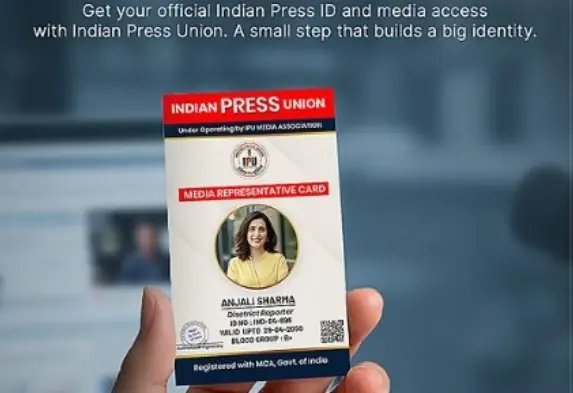
Journalism in India was once considered the voice of truth. Today, it appears to have become a product that can be purchased for just ₹1,799. An advertisement circulating on Facebook under the name “Indian Press Union” openly states: “No exam. No qualification. Simple registration — instant identity.”
In other words, no examination, no qualification and no experience. Just pay the money and obtain a “Media Representative Card” and become a journalist.
Such advertising is not only misleading; it also raises serious questions about the fundamental values and credibility of Indian journalism.
According to the organisation’s own website, indianpressunion.com, it is not a government organisation. It does not provide press accreditation on behalf of the Government of India or any ministry. Its card is described as an “organisational membership” card.
Yet advertisements reportedly use phrases such as “Official IPU ID Card,” “Registered with MCA, Govt. of India,” and “Become a Journalist Now.” To an ordinary person, such language can easily create the impression that the card carries some form of official government recognition.
That raises serious questions about whether such marketing could mislead people about the actual status of the card.
How Is Journalism Being Destroyed?
Making a Mockery of Qualification
Real journalists spend years reporting from the ground, following editorial standards and taking responsibility for what they publish.
But when a person can obtain a press-related identity simply by paying a membership fee, the credibility of the profession can be seriously undermined.
The Market for Questionable Press Identities
Press cards can create an impression of authority.
There have been concerns across the industry about people using questionable media identities to gain access to press conferences, hospitals, courts or other sensitive locations. In some cases, misuse of media identities has also been associated with allegations of intimidation, blackmail or other unlawful activities.
This is why the misuse of press credentials should never be taken lightly.
Genuine Journalists Pay the Price
When “Press” cards become common without clear professional standards behind them, genuine journalists can also suffer.
If every other person begins carrying a press card, government officials and members of the public may eventually start questioning even those journalists who have spent years building their credibility.
The result could be a deeper crisis of trust in journalism.
A Commercial Model?
Phrases such as “Limited Slots” and “Apply Before It Closes” are commonly associated with sales and promotional campaigns.
When such language is used to promote a journalism-related membership, it raises an uncomfortable question:
Is journalism being promoted—or is a commercial product being sold using the image of journalism?
Legal and Ethical Questions
There is an important distinction between organisational membership and official government press accreditation.
A private organisation cannot simply make a person a government-accredited journalist merely by issuing a membership card.
Therefore, any organisation offering press-related membership must ensure that applicants clearly understand what the card represents—and, equally importantly, what it does not represent.
Despite such concerns, similar membership-based models continue to attract attention on social media.
Where Does Journalism Go From Here?
Organisations operating in the media space have a responsibility to protect the credibility of journalism rather than dilute it.
If becoming a “journalist” requires nothing more than paying ₹1,799, while experience, reporting skills, editorial standards and ethical responsibility become secondary, the profession itself risks losing its meaning.
The question is simple but uncomfortable:
Do we want to preserve journalism as a profession built on truth, responsibility and public trust—or are we willing to reduce it to a ₹1,799 product?
Because a press card can identify a member.
It cannot buy credibility. It cannot buy experience. And it certainly cannot buy the public’s trust.