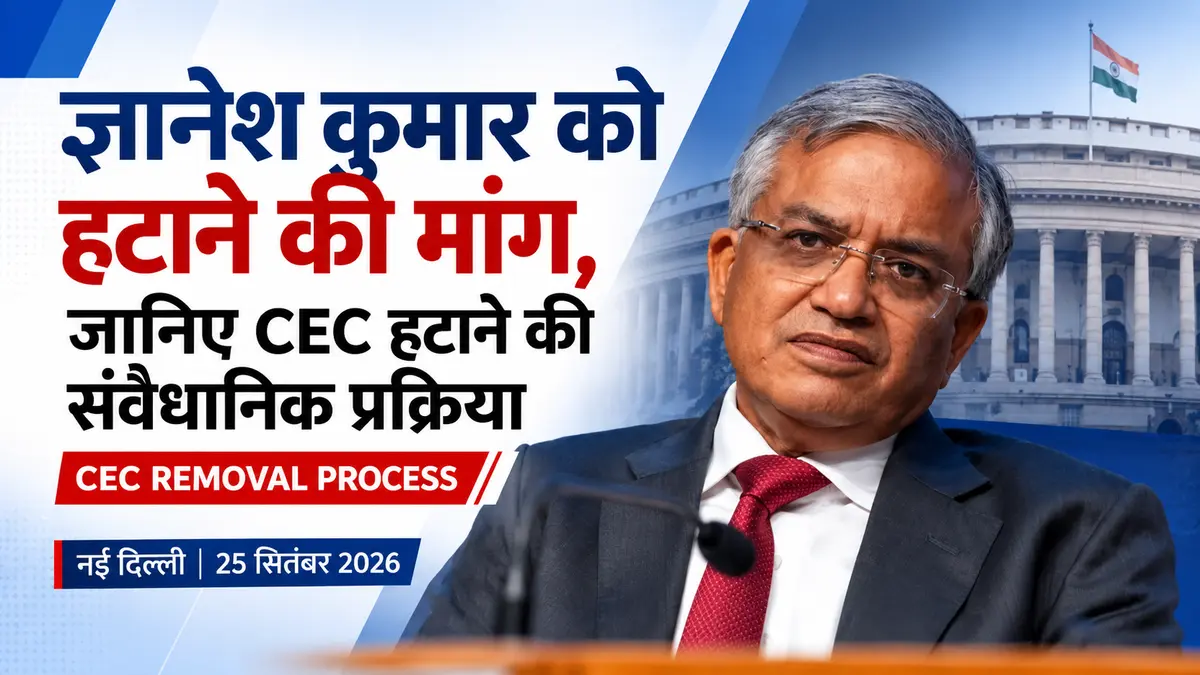
New Delhi, September 25, 2026: Opposition parties are preparing to submit a fresh motion in Parliament seeking the removal of Chief Election Commissioner (CEC) Gyanesh Kumar. Congress sources said the proposed motion is being prepared with the help of legal experts and may be submitted in both the Lok Sabha and Rajya Sabha.
The latest development comes amid renewed political debate over the functioning of the Election Commission of India (ECI), particularly its handling of the Special Intensive Revision (SIR) of electoral rolls.
A recent investigation by The Indian Express reported that Election Commissioners Sukhbir Singh Sandhu and Vivek Joshi had raised objections over several decisions and procedures within the poll panel. The report said concerns were raised over issues linked to electoral-roll procedures and the SIR exercise.
Why Is Removing a CEC Difficult?
The Chief Election Commissioner has special constitutional protection against removal. Article 324(5) of the Constitution provides that the CEC can be removed from office only in the same manner and on the same grounds as a judge of the Supreme Court.
Under Article 124(4), the relevant grounds are proved misbehaviour or incapacity. Therefore, political disagreement or criticism of an Election Commission decision does not by itself establish a constitutional ground for removal.
How Is the CEC Appointed?
The President appoints the Chief Election Commissioner and other Election Commissioners under the constitutional framework and the Chief Election Commissioner and Other Election Commissioners (Appointment, Conditions of Service and Term of Office) Act, 2023.
Under the current law, the selection committee comprises the Prime Minister, the Leader of Opposition in the Lok Sabha and a Union Cabinet Minister nominated by the Prime Minister.
The 2023 law also specifies eligibility requirements relating to senior government experience and knowledge and experience in the management and conduct of elections.
What Is the Tenure of the CEC?
The Chief Election Commissioner and other Election Commissioners can hold office for a maximum of six years or until reaching the age of 65, whichever is earlier.
The CEC's service conditions and financial benefits are protected in a manner comparable to those of a Supreme Court judge.
How Can a Chief Election Commissioner Be Removed?
The removal process begins with a notice for a motion alleging misbehaviour or incapacity.
A notice in the Lok Sabha requires the support of at least 100 MPs, while a notice in the Rajya Sabha requires at least 50 MPs.
However, collecting the required signatures does not automatically remove the CEC. The Speaker of the Lok Sabha or the Chairman of the Rajya Sabha first considers whether the motion should be admitted.
If the motion is admitted, an inquiry committee is constituted to examine the allegations and evidence. The CEC is given an opportunity to respond to the charges during the inquiry process.
If the allegations are established through the prescribed process, the matter proceeds to Parliament.
What Majority Is Required in Parliament?
For removal to take effect, both Houses of Parliament must pass an address seeking the CEC's removal.
The required threshold is a special majority in each House: a majority of the total membership of that House and at least two-thirds of the members present and voting.
Only after the constitutional requirements have been fulfilled can the President issue the order removing the Chief Election Commissioner.
Therefore, simply introducing a motion or obtaining the required number of signatures does not mean that the CEC has been removed.
Has Any CEC Been Removed in India?
No Chief Election Commissioner has so far been removed from office through this constitutional process.
The Opposition has previously attempted to initiate removal proceedings against Gyanesh Kumar in 2026. Earlier notices were not taken forward by the presiding authorities of the two Houses, according to reports.
Opposition parties are now preparing another notice, with reports describing it as their latest attempt to initiate the removal process.
What Is the Current Controversy About?
The latest political dispute is linked largely to the Election Commission's electoral-roll revision exercise and the Special Intensive Revision (SIR).
According to an investigation by The Indian Express, Election Commissioners Sukhbir Singh Sandhu and Vivek Joshi had raised objections over several matters, including procedures relating to electoral rolls and changes concerning Form 6, which is used by eligible citizens to apply for inclusion in the electoral roll.
Opposition parties have cited these reported internal objections while demanding action against the CEC. These are political allegations and demands, however, and do not by themselves establish the constitutional grounds of proved misbehaviour or incapacity.
What Happens Next?
The immediate question is whether the Opposition submits the fresh notices and whether the respective presiding authorities admit them.
If admitted, the matter could proceed through an inquiry and, depending on its findings, consideration by both Houses of Parliament.
The constitutional framework sets a high threshold for removing a CEC. The filing of a motion is therefore only the beginning of a process; it does not itself result in removal from office.
For now, the proposed motion is part of an ongoing political and constitutional debate over the functioning of the Election Commission and its handling of electoral-roll revisions. The final outcome would depend on the formal parliamentary procedure and the constitutional requirements governing removal.
Key Facts at a Glance
- CEC: Gyanesh Kumar
- Constitutional provision: Article 324(5)
- Grounds for removal: Proved misbehaviour or incapacity
- Lok Sabha notice: At least 100 MPs
- Rajya Sabha notice: At least 50 MPs
- Final parliamentary requirement: Special majority in both Houses
- Maximum tenure: Six years or age 65, whichever is earlier