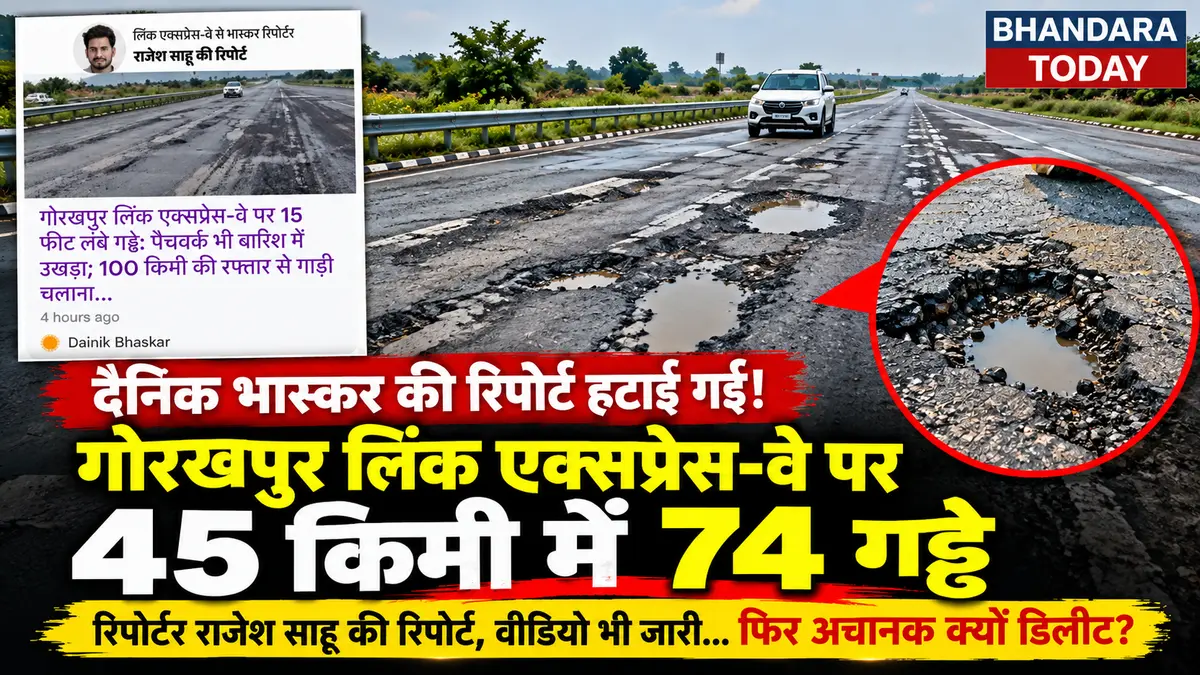
Lucknow/Gorakhpur: Questions are being raised after a report published by Dainik Bhaskar on the condition of the Gorakhpur Link Expressway was reportedly removed from the newspaper’s website shortly after publication. Although the article disappeared from the website, screenshots of the report and its accompanying video had already circulated online and continued to be shared on social media.
The report was published under the name of Dainik Bhaskar senior reporter Rajesh Sahu and was accompanied by a video of around one minute. The video reportedly claimed that 74 potholes had developed across a 45-kilometre stretch of the Gorakhpur Link Expressway within a year.
The issue has attracted attention because the Gorakhpur Link Expressway is a major infrastructure project. The 91-kilometre expressway connects Gorakhpur with the Purvanchal Expressway and was reportedly constructed at a cost of around ₹7,200 crore. Construction began in 2020, while the project was completed in 2025.
With such a large public infrastructure project involved, the removal of a report concerning the road’s condition naturally raises questions about the circumstances behind the decision.
If the report contained factual errors, what exactly was wrong with it? Was a correction or clarification issued before or after the report was removed?
And if the information published in the report was accurate, why was the article taken down from the website?
These are the questions now being discussed online. In the digital age, removing an article from a website does not necessarily erase its existence. Screenshots, videos and copies can continue circulating across social media platforms long after the original publication has disappeared.
The episode has also renewed discussion about transparency in digital journalism. When a published report is subsequently removed, readers may reasonably want to know whether the decision was made because of a factual error, an editorial decision, a legal concern, an update to the information, or some other reason.
There has also been online speculation about whether external pressure could have played a role in the removal. However, there is currently no independently verified evidence establishing that Dainik Bhaskar received money from any political party or that a political party ordered the report to be removed. Such claims should therefore not be presented as established facts without supporting evidence.
At the same time, asking questions about the removal of a published report is legitimate. If the report was wrong, readers deserve to know what was wrong. If it was corrected, the correction should be clear. And if it was removed for editorial or legal reasons, transparency about that decision would help readers understand what happened.
The matter becomes even more significant because the report concerned the condition of a major public infrastructure project involving substantial public expenditure. Claims regarding potholes and road quality can have implications for commuters, road safety, public accountability and the agencies responsible for construction and maintenance.
The controversy, therefore, is no longer limited to the original report. The bigger question is about what happened after the report was published—and why it subsequently disappeared from the website.
The article may have been deleted, but the questions surrounding its removal remain.
The key question is simple: Why was the Gorakhpur Link Expressway report removed from the Dainik Bhaskar website shortly after publication?
Note: The reason for the removal could not be independently established from the information currently available. Claims regarding political payments or external pressure should be treated as allegations or speculation unless supported by verifiable evidence.