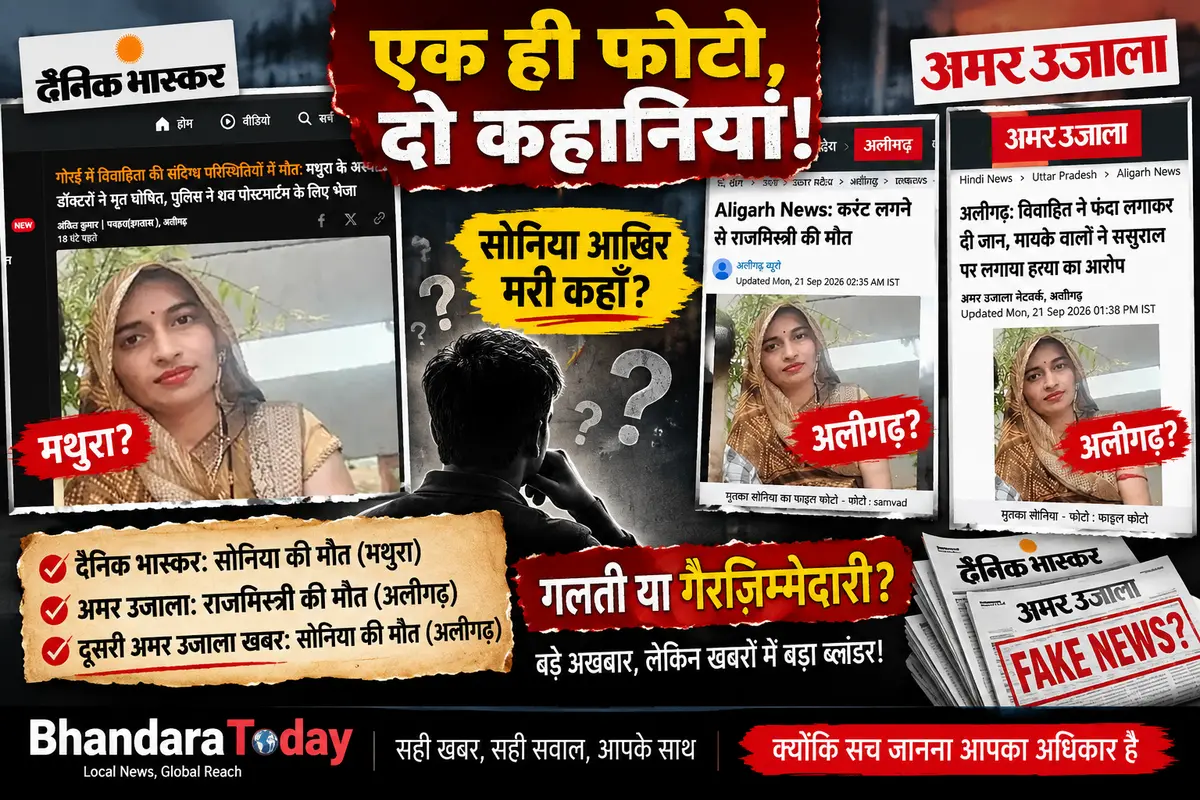
Sometimes you don't need a comedy show when the internet itself provides the content.
Two of India's well-known newspapers, Dainik Bhaskar and Amar Ujala, appear to have published reports involving the same woman, identified as Sonia. However, the details shown in the reports have created a rather confusing situation for readers.
According to the screenshots being circulated, a Dainik Bhaskar report refers to the death of a married woman named Sonia in Mathura under suspicious circumstances.
Then comes the Amar Ujala report.
In a separate report concerning the death of a mason in Aligarh, the photograph used appears to be the same woman, Sonia.
And the confusion doesn't stop there.
Another Amar Ujala report reportedly refers to Sonia's death in Aligarh, creating an obvious question for readers:
Was Sonia's death reported in Mathura or Aligarh?
In This Article
- One Person, Two Locations, Different Reports?
- Journalism Is Not a “Guess the Correct Article” Game
- What Do the Screenshots Actually Show?
- So, Which Newspaper Is Right?
- Why Clarification Matters
- The Question That Remains
One Person, Two Locations, Different Reports?
This is where the whole episode becomes particularly awkward.
If the photographs circulating in these reports are indeed of the same person, and if the reports are referring to the same incident, then the conflicting location details deserve clarification.
Was it Mathura?
Was it Aligarh?
Or are these actually two different incidents involving people with the same name, with a photograph being incorrectly associated with one of them?
That last possibility is important too. Screenshots alone do not establish the complete facts, and an image appearing in two reports does not automatically prove that both reports concern the same individual.
But that's precisely why corrections and clarification matter.
Journalism Is Not a “Guess the Correct Article” Game
Readers shouldn't have to compare screenshots like they're solving a detective puzzle.
Report A: Sonia — Mathura.
Report B: Sonia's photograph — Aligarh.
Report C: Sonia's death — Aligarh.
And the reader:
“Bhai, Sonia आखिर गई कहाँ?”
Jokes apart, mistakes involving names, photographs and locations are not minor formatting errors. In a news report concerning someone's death, accuracy becomes even more important because such reports involve real people and grieving families.
A wrong photograph can misidentify someone. A wrong location can completely change the context of an incident. Once such information spreads across social media, correcting it can also become much harder than publishing it correctly in the first place.
What Do the Screenshots Actually Show?
The screenshots circulating online appear to show differences in the way the incident, location and photograph have been presented.
However, screenshots by themselves cannot establish whether the reports are about the same person or separate incidents involving individuals with the same name.
The original articles, official records and statements from the concerned authorities would be required to establish the complete facts.
Therefore, the apparent discrepancy should be treated as a matter requiring verification rather than an established conclusion.
So, Which Newspaper Is Right?
That's the million-rupee question — and the screenshots alone don't provide enough evidence to answer it responsibly.
Rather than declaring Dainik Bhaskar right or Amar Ujala wrong, the sensible approach is to verify the original reports, police or official statements, and the identities involved.
Until that clarification comes, all that can reasonably be said is that the reports, as presented in the screenshots, appear confusing and deserve an explanation.
Why Clarification Matters
Accuracy is particularly important when a news report concerns someone's death. Names, photographs, locations and other identifying details should be checked carefully before publication.
If an incorrect photograph or location has been published, a clear correction can help prevent further confusion and reduce the possibility of misinformation spreading online.
For readers, the best course is to avoid treating an unverified screenshot as the complete story and instead look for the original report or an official confirmation.
The Question That Remains
Ultimately, journalism should not leave readers trying to determine which version of a story is genuine.
If the reports concern the same person, then the conflicting details clearly need an explanation.
If they concern different individuals, that distinction should also be made clear to readers.
Until then, the screenshots leave behind a rather uncomfortable question:
What exactly happened — Mathura or Aligarh?
If there is an editorial or photo error, the simplest and most professional solution is:
Clarify it. Correct it. And move on.