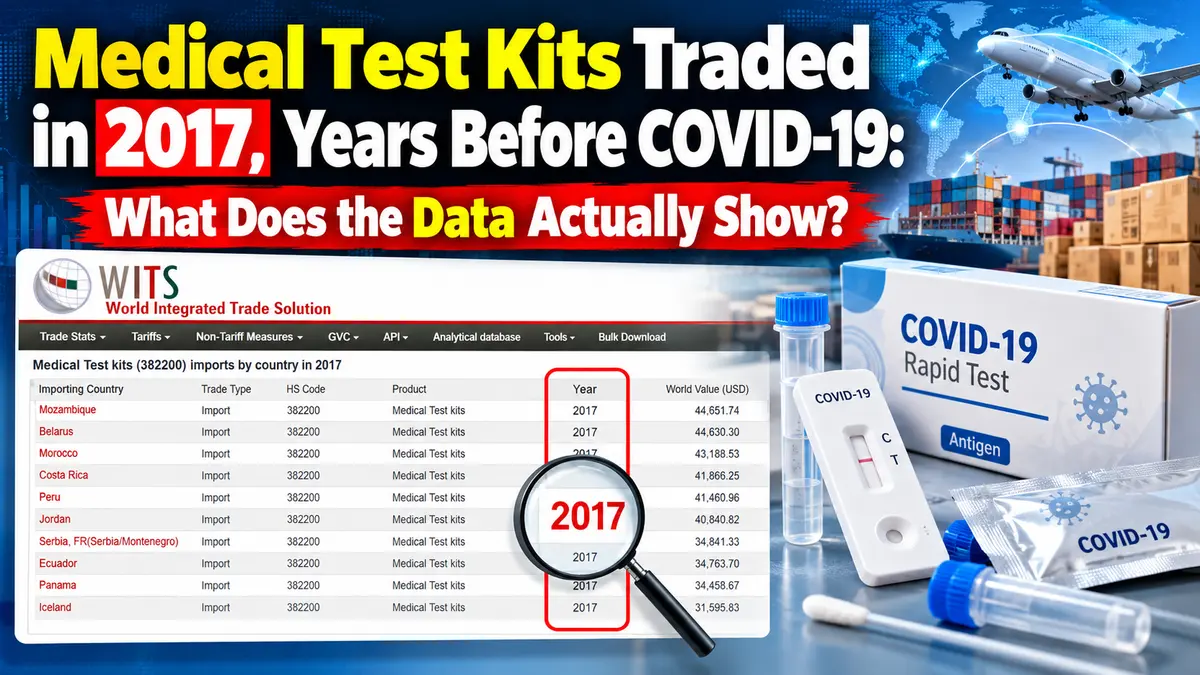
**New Delhi/Greenbelt:** The guilty plea of former National Institute of Allergy and Infectious Diseases (NIAID) senior adviser **David M. Morens** in a federal case involving the concealment of government records during the COVID-19 pandemic has renewed attention on coronavirus research, government communications and research grants. At the same time, data from the World Bank's **World Integrated Trade Solution (WITS)** database showing international trade in products classified as “Medical Test kits” under **HS Code 382200** in 2017 has prompted questions online.
According to WITS, countries were already importing and exporting products under HS 382200 in 2017. The database records **$412.65 million in imports by <a href="/category/india" class="text-brand font-semibold hover:underline">India</a>**, while the United States recorded imports worth about **$3.39 billion**. China recorded imports of approximately **$1.54 billion**, while Germany recorded nearly **$2.94 billion**. The European Union's imports were about **$4.11 billion**.
But there is an important distinction: **these figures do not establish that COVID-19-specific test kits were being manufactured or sold in 2017.**
## What Is HS Code 382200?
The Harmonized System, or **HS**, is an international system used to classify products traded across borders.
WITS currently labels HS 382200 as **“Medical Test kits”** and provides additional information describing the category in connection with diagnostic reagents, including PCR-based nucleic-acid testing. However, WITS also explicitly notes that the 2017 data track **medical devices that already existed at the time and were later classified by the World Customs Organization as critical to tackling COVID-19**.
This distinction is important.
A product being listed under a particular HS code does not automatically mean that the product was designed for SARS-CoV-2 or COVID-19.
## Did COVID-19 Test Kits Exist in 2017?
The available trade data do **not prove that COVID-19 test kits existed in 2017**.
SARS-CoV-2 was identified years later, during the emergence of COVID-19. Therefore, the presence of diagnostic products in international trade records from 2017 should not by itself be interpreted as evidence that those products were specifically designed to detect the virus that causes COVID-19.
The same trade classification could cover diagnostic technologies and reagents used for other diseases and laboratory applications.
The World Customs Organization's later COVID-19 classification reference shows that certain COVID-19 diagnostic reagents, including PCR-based diagnostic reagents, fall within the broader HS 3822 family.
## What Does the 2017 Data Actually Tell Us?
The WITS figures demonstrate that a **large international market for diagnostic and laboratory products already existed before the COVID-19 pandemic**.
The 2017 import data include:
* **European Union:** about $4.11 billion
* **United States:** about $3.39 billion
* **Germany:** about $2.94 billion
* **China:** about $1.54 billion
* **France:** about $1.51 billion
* **India:** about $412.65 million
WITS reports these figures in thousands of U.S. dollars and also provides quantities for many countries. For example, India's 2017 imports under HS 382200 were reported at approximately **$412.65 million and 8.15 million kg**.
These figures demonstrate the existence of a substantial diagnostic-products market. They do **not**, on their own, identify the products as COVID-19 tests.
## Why Has the Data Created Confusion?
The confusion appears to come partly from the way historical trade data are displayed today.
WITS uses a classification reference connected to COVID-19 medical supplies when presenting this category. Its page specifically states that the data concern **previously existing medical devices that were later classified as critical for tackling COVID-19**.
As a result, a reader looking at a page titled “Medical Test kits” for 2017 may incorrectly assume that the listed products were COVID-19 test kits.
The trade records themselves do not support that conclusion.
## What About the David Morens Case?
The trade-data question has also been discussed alongside the federal case involving former NIAID senior adviser **David M. Morens**.
According to the U.S. Department of Justice, Morens pleaded guilty in August 2026 to conspiracy to commit offenses and to defraud the United States. Prosecutors said he and other individuals used his personal Gmail account rather than his official NIH email to communicate about coronavirus research grants and other matters that prosecutors said constituted federal records.
The DOJ also said that the case involved a grant titled **“Understanding the Risk of Bat Coronavirus Emergence,”** which had been terminated by NIH. According to the guilty plea, communications were also related to efforts concerning the grant and the debate over whether COVID-19 emerged from a laboratory.
The case additionally involved an admitted scheme concerning illegal gratuities, including wine given to Morens. Prosecutors said Morens identified an official act he could perform in connection with the gift, involving a scientific commentary advocating natural origins for COVID-19.
Morens faces a maximum sentence of **five years in prison** on the conspiracy charge, although the actual sentence will be determined by the federal court after considering applicable sentencing guidelines and other statutory factors.
## Is There a Direct Link Between the 2017 Trade Data and the Morens Case?
Based on the available records, **no direct connection has been established between the 2017 HS 382200 trade data and the Morens federal case**.
The two issues should therefore be treated separately.
**The first issue:** International trade in diagnostic and laboratory products clearly existed years before COVID-19.
**The second issue:** The Morens case concerns alleged concealment of federal records and communications related to coronavirus research grants during the COVID-19 pandemic.
The existence of medical diagnostic-product trade in 2017 does not, by itself, establish a connection to the later COVID-19 pandemic, nor does it prove that COVID-19 testing programs existed before the virus was identified.
## The Bottom Line
The 2017 WITS data show that **medical diagnostic and laboratory products were already traded internationally on a large scale years before the COVID-19 pandemic**. India's imports under HS 382200 alone were reported at approximately $412.65 million in 2017.
However, the data should not be presented as proof that **COVID-19-specific test kits were being sold in 2017**.
The key point is that HS 382200 represents a broader category of diagnostic products. Some products within that broader classification later became relevant to COVID-19 testing and were classified as critical medical supplies during the pandemic.
Meanwhile, the Morens case concerns federal records, FOIA requirements and communications surrounding coronavirus research grants. The available evidence does not establish a direct link between that case and the 2017 international trade figures.
**In short: the 2017 trade data are real, but what they prove is the existence of a pre-existing diagnostic-products market—not the existence of COVID-19 test kits before the pandemic.**