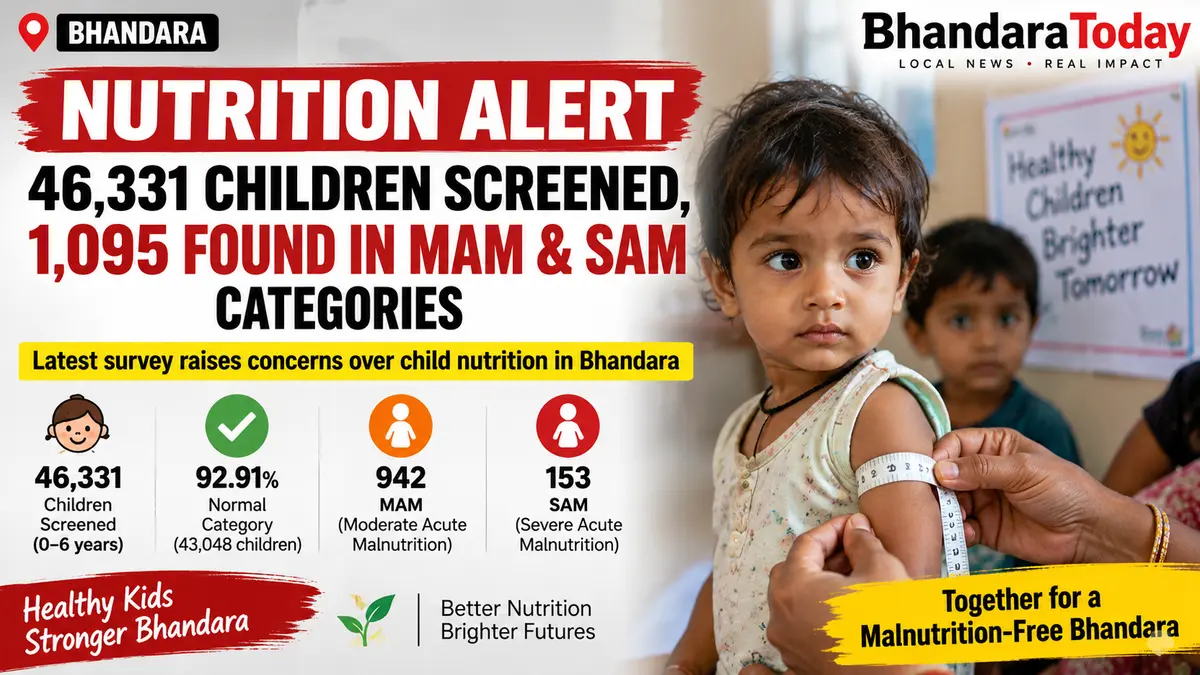
BHANDARA: A district-wide nutrition survey conducted in Bhandara during the National Nutrition Week has highlighted both positive and concerning aspects of child nutrition. Under all seven Child Development Project areas in the district, 46,331 children aged 0 to 6 years were weighed and screened to assess their nutritional status.
According to the survey, 43,048 children, or 92.91 percent, were found to be in the normal category. However, several children were also identified with low weight and different levels of malnutrition.
The data shows that 2,822 children were underweight, 461 were severely underweight, 942 were classified as Moderate Acute Malnutrition (MAM), and 153 were identified as Severe Acute Malnutrition (SAM).
The findings highlight the continuing challenge of tackling malnutrition among children in Bhandara and underline the importance of active participation by both government agencies and families.
153 Children Identified as SAM; Lakhandoor Leads the List
Among the seven Child Development Project areas, the Lakhandoor project recorded the highest number of children in the SAM category.
Of the 5,181 children screened in Lakhandoor, 47 were identified as SAM, accounting for 0.91 percent of the children surveyed there.
The figures for other project areas were 30 SAM children in Mohadi, 19 in Tumsar, 18 in Lakhani, 15 in Bhandara, 14 in Pauni and 10 in Sakoli.
Lakhandoor also recorded the highest SAM percentage at 0.91 percent. The corresponding figures were 0.39 percent in Mohadi, 0.36 percent in Lakhani, 0.22 percent in Tumsar, 0.24 percent in Pauni, 0.20 percent in Sakoli and 0.17 percent in Bhandara.
Across the district, the overall proportion of children identified as SAM was 0.33 percent.
942 Children Found in the MAM Category
The survey also identified 942 children with Moderate Acute Malnutrition (MAM) across Bhandara district.
Mohadi recorded the highest number, with 201 children in the MAM category. This was followed by Lakhandoor with 156, Bhandara with 146, Lakhani with 145, Tumsar with 134, Pauni with 87 and Sakoli with 73 children.
The total of 942 MAM cases represents approximately 2.03 percent of the children surveyed.
54 Village Child Development Centres Operating for SAM Children
To help bring severely malnourished children back into the normal nutritional category, 54 Village Child Development Centres are being operated across the district.
Children identified in the SAM category are provided energy-rich nutritional food for 84 days at these centres. Their weight is monitored regularly, while health check-ups and necessary medicines are also provided.
The objective is not merely to identify malnourished children but to provide sustained nutritional and healthcare support to improve their health and bring them into the normal category.
Anganwadi Centres at the Centre of Nutrition Programmes
The Women and Child Development Department is implementing various nutrition-related programmes through Anganwadi centres across Bhandara.
The programmes focus on pregnant women, breastfeeding mothers and children up to six years of age, with an emphasis on nutrition awareness, health monitoring and counselling.
Home visits, counselling sessions, health camps, Nutrition Week activities and awareness programmes are being used to educate families about proper nutrition, child health and regular monitoring.
Survey Conducted Through 1,144 Anganwadi and 108 Mini Anganwadi Centres
The district-wide screening was conducted through 1,144 Anganwadi centres and 108 Mini Anganwadi centres.
A total of 46,331 children were screened. Bhandara project recorded the highest number of children surveyed, with 8,826 children.
This was followed by Tumsar with 8,725, Mohadi with 7,753, Pauni with 5,764, Lakhandoor with 5,181, Sakoli with 5,128 and Lakhani with 4,954 children.
The survey provided a comprehensive assessment of the nutritional status of children in the 0–6 age group across the district.
Focus on Making Bhandara Malnutrition-Free
The district administration is continuing efforts to reduce malnutrition through village-level monitoring and awareness programmes.
Anganwadi workers, supervisors and ASHA workers are playing an important role in monitoring children and educating families about nutrition and healthcare.
While the fact that 92.91 percent of surveyed children were found to be in the normal category is a positive indicator, the presence of children in the MAM and SAM categories shows that continued intervention remains necessary.
Regular monitoring of severely malnourished children, active participation from families and timely access to nutrition and healthcare services will remain crucial to achieving the goal of a malnutrition-free Bhandara.
According to Sanjay Jolhe, Women and Child Development Officer, continuous awareness and monitoring activities are being carried out at the village level with the objective of making Bhandara free from malnutrition.
Bhandara Today Analysis
The latest nutrition survey presents a mixed picture of child health in Bhandara. On one hand, more than 43,000 children were found to be in the normal nutritional category. On the other, 1,095 children were identified under the MAM and SAM categories combined.
The figures indicate that while significant progress has been made, sustained efforts are still required to ensure that every child identified with malnutrition receives timely nutritional and healthcare support.
For Bhandara to achieve its goal of becoming malnutrition-free, the focus must now remain on early identification, continuous monitoring, family participation and effective delivery of nutrition services to vulnerable children.
Source/Official Statement: Sanjay Jolhe, Women and Child Development Officer, Bhandara.