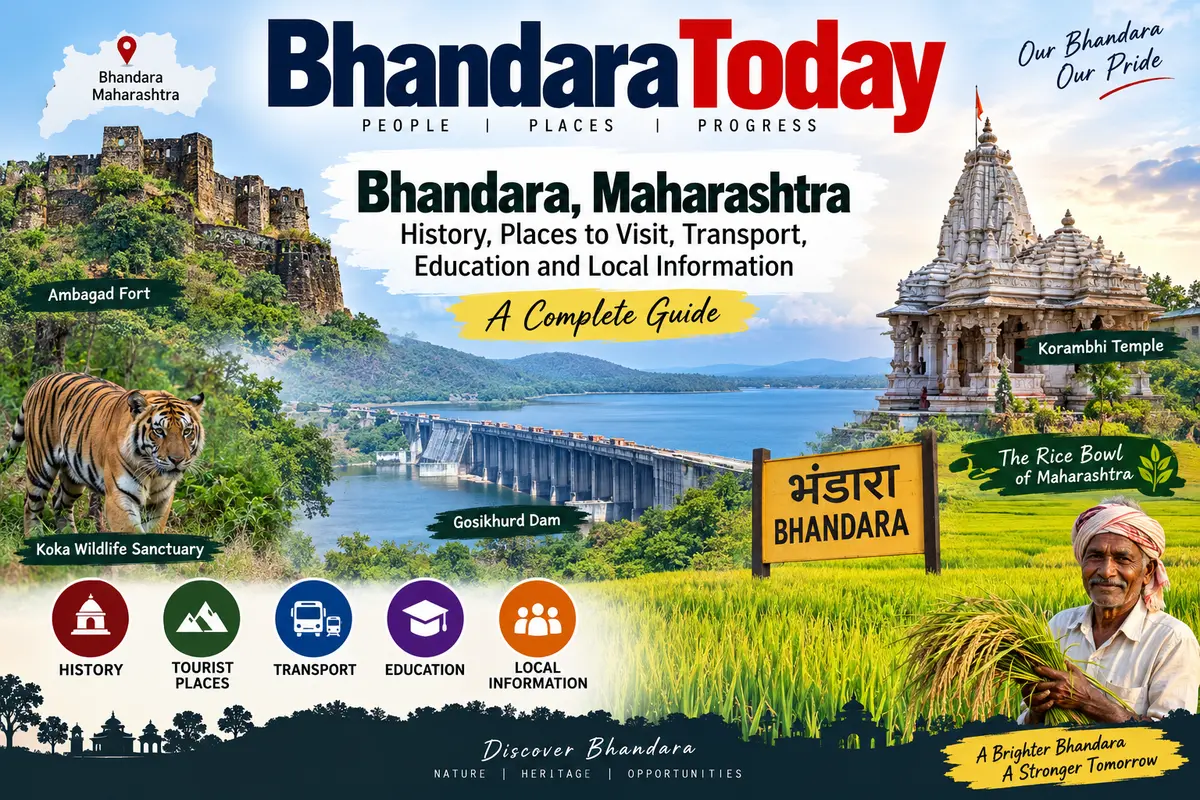
Bhandara, Maharashtra: If you are looking for a place in Vidarbha where history, agriculture, forests and everyday local life come together, Bhandara deserves a closer look.
Located in eastern Maharashtra, Bhandara is known for its rice fields, the Wainganga river system, forests, reservoirs and historical places. The district is popularly known as the “Rice Bowl of Maharashtra”, while its brass industry has also contributed to its identity as the “Brass City.”
From old forts and temples to wildlife sanctuaries and major irrigation projects, Bhandara offers a combination of history, nature, agriculture and local culture that makes it an interesting destination in the Vidarbha region.
Where is Bhandara located?
Bhandara is a district in eastern Maharashtra and forms part of the Vidarbha region. The district lies within the Wainganga river basin, with the Wainganga and Bawanthadi rivers being important geographical features of the area.
Bhandara city serves as the administrative headquarters of the district. The district has seven tahsils and includes a mix of urban settlements, agricultural areas, forests and villages.
According to the district administration's Census-based information, Bhandara had 864 villages and 12 towns in the 2011 Census. The district's landscape changes considerably as one moves from the main city towards rural areas, forests, rivers and water reservoirs.
The history behind Bhandara
Bhandara has a long and interesting history. The official district administration says that the name Bhandara is locally considered a variation of “Bhanara.” A reference to Bhanara appears in an inscription dating back to around 1100 AD at Ratanpur.
Over the centuries, the region passed through different administrative and political phases. According to the district administration, the headquarters were shifted from Lanji to Bhandara around 1820–21. The area subsequently came under British territory in 1853.
After India's Independence, Bhandara became part of the Central Provinces and later Madhya Pradesh. During the reorganisation of states in 1956, it became part of Bombay State. After Maharashtra was formed in 1960, Bhandara became part of the newly created state.
A major change in the district's modern administrative boundaries came in 1999, when Gondia was separated from Bhandara and became a separate district.
Why rice is so important to Bhandara
Rice is one of the strongest symbols of Bhandara. Agriculture continues to play an important role in the district's economy, and rice cultivation is particularly significant.
The Maharashtra government's One District One Product initiative identifies rice and mineral ores among Bhandara's district products. Traditional rice varieties associated with the region include Chinnor, Dubhraj and Kalikammod.
Bhandara's rice industry goes beyond farming. Rice mills, processing units, packaging businesses and other related activities contribute to the local economy. The district's agricultural identity is therefore closely connected with its small-scale industrial and commercial activities.
Places worth visiting in Bhandara
Bhandara's tourist attractions are spread across different parts of the district. Visitors can find historical forts, temples, dams, forests and wildlife areas rather than a single concentrated tourist zone.
1. Ambagad Fort
Ambagad Fort is one of Bhandara's notable historical attractions. The fort is located in Tumsar taluka and is around 13 km from Tumsar according to information provided by the district administration.
Official records state that the fort was constructed around the early 1700s by Raja Khan Pathan, a subhedar associated with Bakht Buland Shah of Devgadh. It later came under the control of Raja Raghuji Bhosale of Nagpur and was used as a prison.
Today, Ambagad Fort attracts people interested in history, architecture, trekking and the natural surroundings of the area.
2. Koka Wildlife Sanctuary
Koka Wildlife Sanctuary is one of the important natural attractions around Bhandara. The sanctuary is located relatively close to the district headquarters and offers visitors an opportunity to experience the region's forests and biodiversity.
The area can be of particular interest to wildlife enthusiasts, nature photographers and people looking for a peaceful break away from the city.
Visitors planning a trip should check current forest department guidelines, entry rules and local conditions before travelling.
3. Umred-Karhandla Wildlife Sanctuary
The Umred-Karhandla Wildlife Sanctuary is another important wildlife destination associated with Bhandara district. The sanctuary extends into parts of Bhandara as well as Nagpur district.
The area is known for its forest ecosystem and wildlife, including species such as tigers, leopards and several varieties of birds. It is also connected with the wider forest landscape of central Maharashtra.
For anyone interested in wildlife tourism, the sanctuary can be included in a broader Vidarbha travel plan.
4. Gosikhurd or Indira Sagar Dam
The Gosikhurd Project, also known as the Indira Sagar Project, is one of the major water projects associated with the Bhandara region.
The project was developed primarily for irrigation and has importance for agriculture across parts of Vidarbha. The large reservoir and surrounding landscape also make the area attractive for visitors interested in scenic locations.
The Bhandara district administration lists the project among the important places of interest in the district.
5. Rawanwadi Dam
Rawanwadi Dam is another water-based destination in Bhandara. It is officially associated with an irrigation project and is surrounded by a landscape that attracts local visitors.
The location can be suitable for people looking for a short outing, especially during periods when the surrounding landscape is green and the reservoir is filled.
6. Korambhi Temple
Korambhi Temple is located in Korambhi village near Bhandara. The temple has religious importance for local residents and is also included among the district's tourist attractions.
Its proximity to Bhandara city makes it relatively convenient to include in a short local trip.
7. Maha Samadhi Bhumi
Maha Samadhi Bhumi is another destination listed by the Bhandara district administration. The site is associated with the Buddhist heritage of the region and attracts visitors interested in spirituality, history and culture.
8. Pauni and its historic character
Pauni is another interesting destination in Bhandara district. Located along the Wainganga, the town has historical and religious significance.
Pauni is also known for its historic fort. Maharashtra Tourism describes Pauni Fort as a historic structure surrounded by a moat on three sides, while the Wainganga forms a natural boundary on the fourth side.
For travellers interested in lesser-known historical destinations, Pauni can be an interesting addition to a Bhandara itinerary.
How to reach Bhandara
By Air
The nearest major airport is Dr. Babasaheb Ambedkar International Airport in Nagpur.
The Bhandara district administration lists the airport at approximately 65 km from Bhandara. From Nagpur airport, travellers can continue to Bhandara by road using buses, taxis or private vehicles.
By Train
Rail connectivity is another convenient way to reach Bhandara.
The district administration's official travel information refers to Warthi Railway Station for travel between Nagpur and Bhandara. The Nagpur-to-Warthi journey is described as approximately one hour, although actual travel time depends on the train and schedule.
Travellers should check the latest railway timetable before planning their journey.
By Road
Bhandara has road connectivity with Nagpur and other parts of Maharashtra. The district administration lists the Nagpur–Pardi–Bhandara route and gives the distance between Nagpur and Bhandara at approximately 60 km by road.
Private cars, taxis and buses are commonly used for travelling between Nagpur and Bhandara.
Education in Bhandara
Education is another important part of Bhandara's local infrastructure. The district has schools, colleges and institutions offering education in different streams.
The government education departments in the district oversee primary and secondary education, school infrastructure and various government education programmes.
Students and parents looking for admission, examination, scholarship or other education-related information should check the latest information from the concerned institution or government department because rules, dates and eligibility requirements can change.
Bhandara's economy beyond agriculture
Although rice is strongly associated with Bhandara, agriculture is not the district's only economic activity.
Bhandara also has important mineral resources. The district's Mining Department identifies manganese ore as one of the important minerals found in the region. Other minerals listed by the administration include iron ore, chromite, corundum, kyanite, sillimanite and quartz.
The combination of agriculture, rice processing, mineral resources, small businesses and local services contributes to Bhandara's overall economic profile.
Government services in Bhandara
The Bhandara district administration website provides information about a wide range of government departments and public services.
These include departments related to revenue, agriculture, education, health, public works, forests, social welfare, women and child development, employment and entrepreneurship, transport and other public services.
Residents can also find information and links related to online government services through the official district portal.
For certificates, government schemes, applications and official procedures, residents should preferably use the latest official government portals instead of relying on old social media posts or unofficial websites.
Best time to visit Bhandara
Maharashtra Tourism currently lists July to March as a suitable period for visiting Bhandara.
The ideal time can depend on the purpose of the trip. During the monsoon and post-monsoon period, the greenery around forests, dams and rural areas can make the landscape particularly attractive.
Visitors planning wildlife trips should check current weather conditions, sanctuary rules, safari availability and forest department instructions before travelling.
How many days are enough for Bhandara?
For a basic visit, one to two days can be enough to explore selected attractions in and around Bhandara.
A longer trip can be useful if you want to combine historical locations, wildlife areas, temples, dams and nearby towns without rushing through the itinerary.
A short itinerary could include Bhandara city along with places such as Koka, Rawanwadi, Korambhi or other nearby attractions. Visitors with more time can explore destinations such as Pauni and Ambagad Fort.
Why Bhandara deserves more attention
Bhandara may not have the same tourism profile as some of Maharashtra's better-known destinations, but the district has a distinctive character of its own.
Its identity is closely connected with rice cultivation, the Wainganga river, forests, historical forts, temples, wildlife and large reservoirs.
What makes Bhandara interesting is that its attractions are spread across the district and remain closely connected with local life. Visitors can move from a busy town area to agricultural villages, forests or water bodies within a relatively short journey.
For travellers coming from Nagpur or exploring Vidarbha, Bhandara can be a useful starting point for discovering a different side of Maharashtra.
It is a district where agriculture continues to shape the local economy, historical structures preserve stories from earlier periods, and natural landscapes remain an important part of everyday life.
Frequently Asked Questions
What is Bhandara famous for?
Bhandara is particularly known for rice cultivation, forests, water bodies, wildlife and mineral resources. The district is popularly known as the Rice Bowl of Maharashtra.
Which are the main tourist places in Bhandara?
Some of the major attractions include Ambagad Fort, Koka Wildlife Sanctuary, Umred-Karhandla Wildlife Sanctuary, Gosikhurd Dam, Rawanwadi Dam, Korambhi Temple, Maha Samadhi Bhumi and Pauni.
How far is Bhandara from Nagpur?
The Bhandara district administration lists the Nagpur–Pardi–Bhandara road route at approximately 60 km.
Which railway station serves Bhandara?
Warthi Railway Station is the railway station referenced by the Bhandara district administration for travel between Nagpur and Bhandara.
What is Bhandara's main agricultural product?
Rice is one of Bhandara's major agricultural products and is included in the district's One District One Product initiative.
Which wildlife sanctuaries are associated with Bhandara?
Koka Wildlife Sanctuary and Umred-Karhandla Wildlife Sanctuary are among the important wildlife destinations associated with Bhandara district.
Is Bhandara good for a short trip?
Yes. A one- or two-day trip can cover selected attractions, while a longer stay allows visitors to explore more historical places, wildlife areas, temples and surrounding landscapes.
What is the best time to visit Bhandara?
Maharashtra Tourism currently lists July to March as a suitable period to visit Bhandara. Visitors should consider weather conditions and the purpose of their trip before finalising travel plans.